Platform 3
The Swiss Table
Swiss food is mountain food first: warm, filling and made to share after a long day outside. Every region adds something of its own, from Italian risotto in Ticino to French pastries in Geneva.
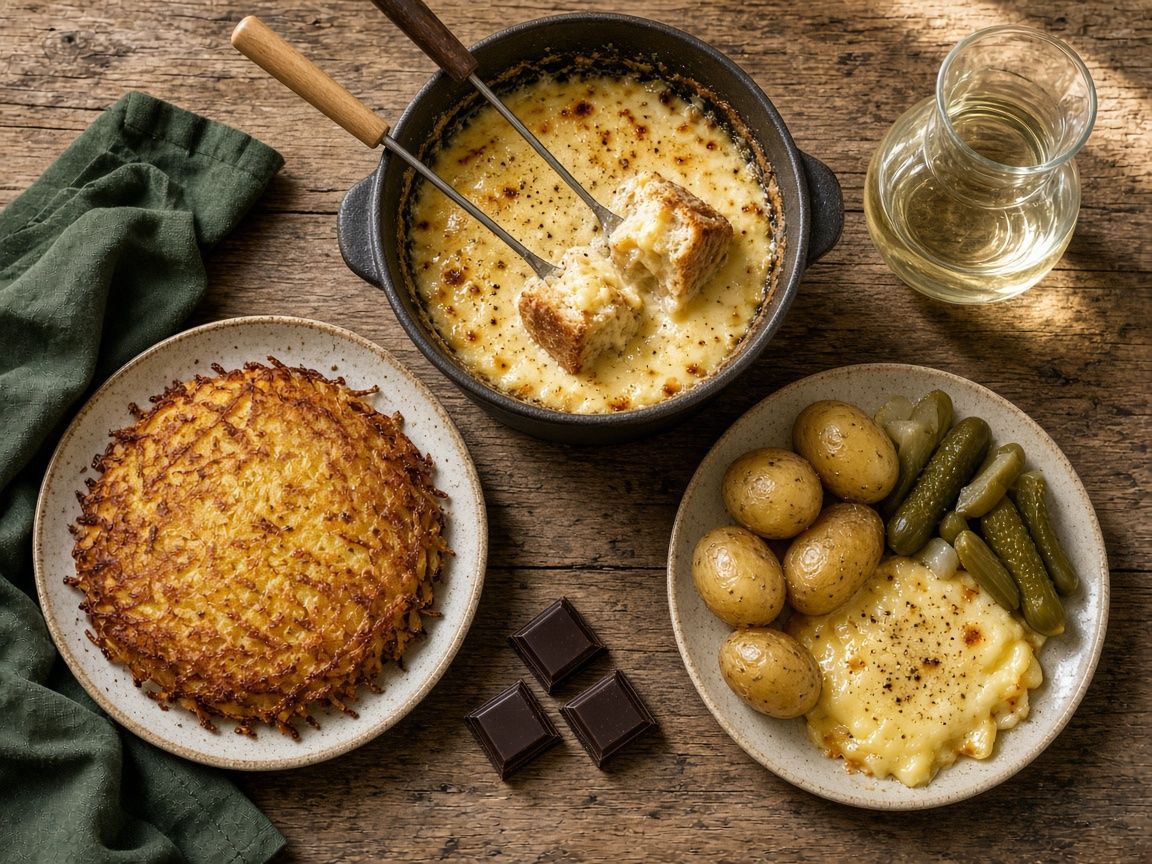
Dishes worth knowing
| Dish | What it is | Where you meet it |
|---|---|---|
| Fondue | Cheese melted with white wine in a shared pot, with bread on long forks | Everywhere, especially in the cold months |
| Raclette | A wheel of cheese melted and scraped over boiled potatoes, with pickles and small onions | Valais, and winter tables nationwide |
| Rösti | Grated potato fried into a golden cake | Bern and the German-speaking north |
| Zürcher Geschnetzeltes | Thin strips of veal in a creamy mushroom sauce, served with rösti | Zurich |
| Älplermagronen | Pasta and potatoes baked with cheese, served with apple sauce | Alpine huts and central Switzerland |
| Risotto and polenta | Slow-stirred rice and cornmeal | Ticino and the southern valleys |
| Bündner Nusstorte | A caramel and walnut tart in shortcrust pastry | Graubünden, especially the Engadine |
| Bircher muesli | Soaked oats with grated apple and nuts, created around 1900 by Dr Maximilian Bircher-Benner | Breakfast tables and station cafés |
Fondue manners
- Stir with your bread in a figure of eight as you dip. It keeps the pot smooth.
- Do not put your fork in your mouth and back into the pot. Slide the bread onto your plate first.
- Lose your bread in the pot, and tradition says you owe the table a forfeit, often a round of drinks.
- Many Swiss people drink white wine or warm tea with fondue rather than cold drinks. It is a folk habit more than a rule.
- The toasted crust at the bottom of the pot, called la religieuse in French-speaking areas, is shared at the end.
The Röstigraben
Swiss people jokingly call the cultural line between the German-speaking and French-speaking parts of the country the Röstigraben, the rösti ditch. It runs roughly along the Sarine river around Fribourg, and it shows up in voting patterns, television habits and, of course, breakfast.
Chocolate and sweet things
Swiss chocolate makers helped shape modern chocolate. Rodolphe Lindt in Bern developed conching in 1879, a long stirring process that gives chocolate its smooth texture. Today almost every town has a chocolatier, and supermarket bars are good enough to bring home. Look out too for Basler Läckerli, a spiced honey biscuit from Basel, and meringues served with thick cream in the Emmental and Gruyère regions.
Markets and everyday eating
- Weekly markets. Most towns have a market morning, often on a Tuesday, Thursday or Saturday, with vegetables, bread, flowers and cured meats.
- Grotti. In Ticino, simple rustic restaurants called grotti serve local food at stone tables under the trees.
- Sunday bread. A plaited loaf called Zopf is a Sunday-morning favourite in the German-speaking part.
- Sausages. The cervelat is often called the national sausage, grilled over a fire on a hike.
Money and water. Service is already included in Swiss menu prices, so tipping is optional; rounding up for good service is common. The water in most public fountains is drinkable unless a sign says otherwise, so carry a bottle.